Ashlands: Feed the Dragons

ONE KINGDOM. ONE TRIBUTE. ONE DECISION.

Survive the
fury of the dragons.

Every turn demands a sacrifice. Feed the dragons, protect your Villagers, and keep your kingdom standing until the end.

  • 2–5 players
  • 30–90 minutes
STRATEGY · SURVIVAL · DARK FANTASYBASE GAME / FIRST EDITION

ASHLANDS: FEED THE DRAGONS

Your kingdom lives.
The dragon is always hungry.

Manage Animals, Villagers, and cards as the world of Ashlands turns against you. Recruit allies, react to your opponents, and decide what you are willing to sacrifice.

If you run out of Villagers, your kingdom falls. The last player with Villagers in their kingdom wins.

115base-game cards, including 15 starters
50Villager tokens
3cards drawn per turn
5cards in hand at the end of your turn

YOUR FIRST GAME

From the first deal
to the final tribute.

Set up the table and follow the phases in order. Printed card abilities take precedence when they contradict a general rule.

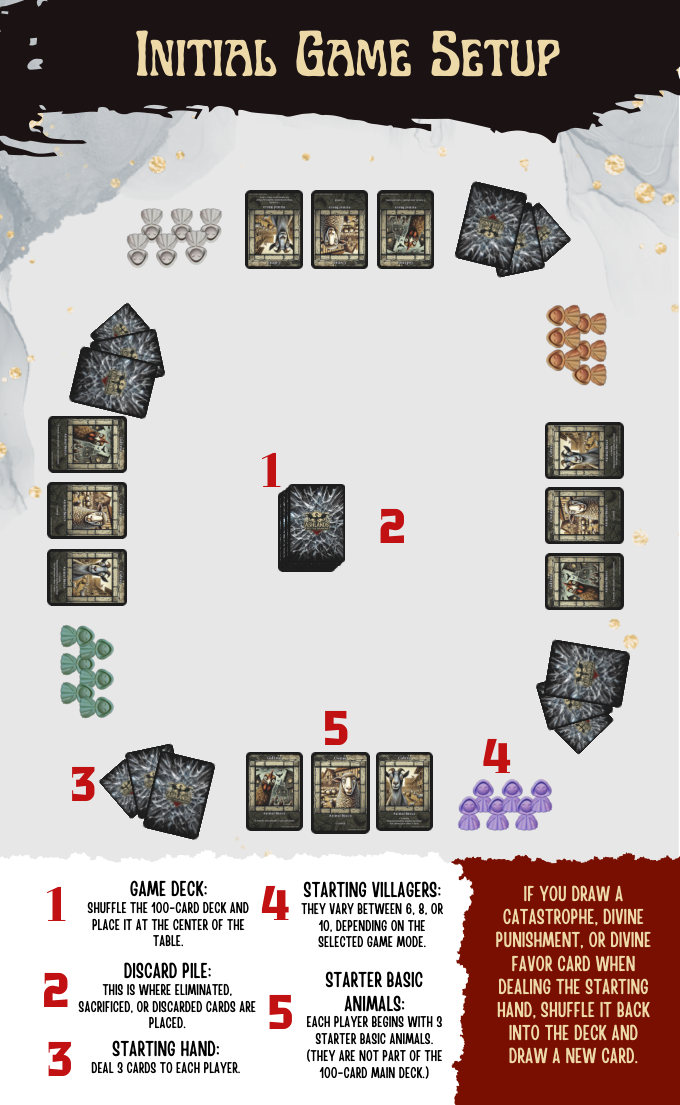
Initial game setup from the English rulebook

01 / Prepare your kingdom

Chaos Mode: start with 6 Villagers in your kingdom.

  1. Receive 3 cards in hand and 3 Starter Basic Animals: Chickens, Goats, and Sheep.
  2. Shuffle the 100-card base-game deck. Keep the 15 Starter Basic Animals separate. You may customize the deck with promotional and expansion cards; the manual recommends keeping the proportions and a total of 100 cards plus starters.
  3. If you draw a Catastrophe, Divine Punishment, or Divine Favor while dealing starting hands, shuffle it back into the deck and draw a replacement.
  4. Optionally choose the starting player by shuffling one face-down Chickens card with the other Starter Basic Animals: whoever draws it begins. Play continues clockwise.

THE TURN, STEP BY STEP

02 / Keep your kingdom alive for another turn

Step 1 of 5

TURN PHASES

A sequence to keep
your kingdom standing.

Your turn starts with the Untap Phase. Follow these five main phases in order. FEED THE DRAGONS contains the Tribute Phase and the Bribe the Dragon Phase. Dismiss and Discard are part of the Final Phase.

Activate abilities of your cards in play during the Action Phase, unless the card states otherwise. If a card’s ability contradicts a general rule, the card’s ability takes precedence. Read the turn phases in the English manual.

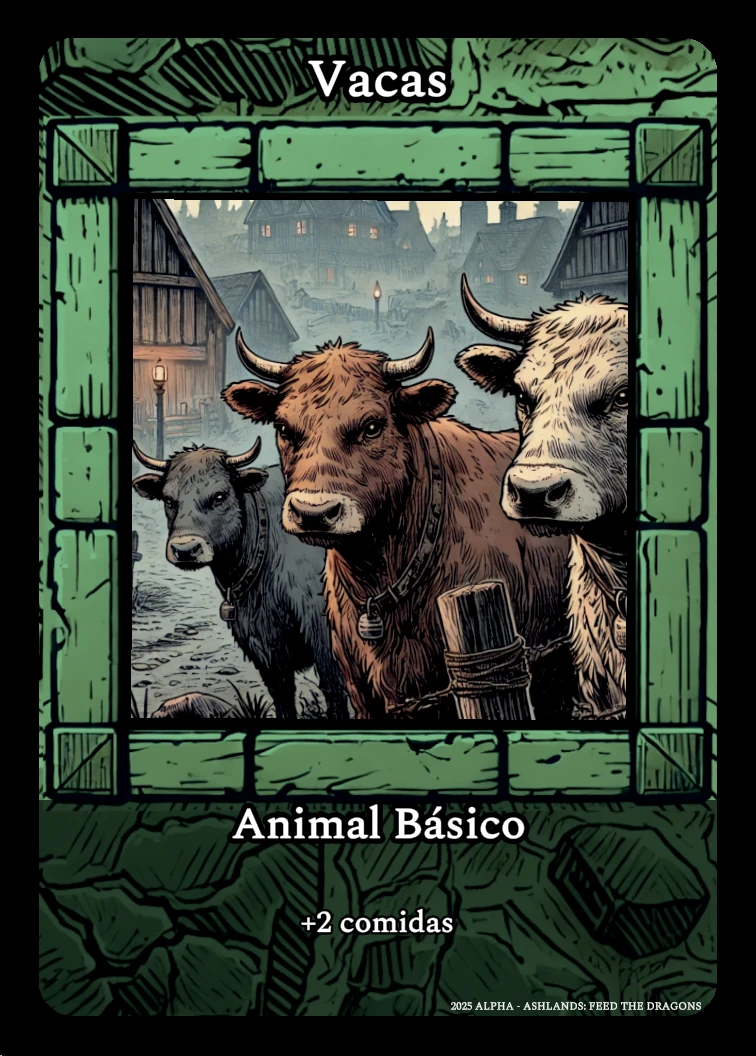
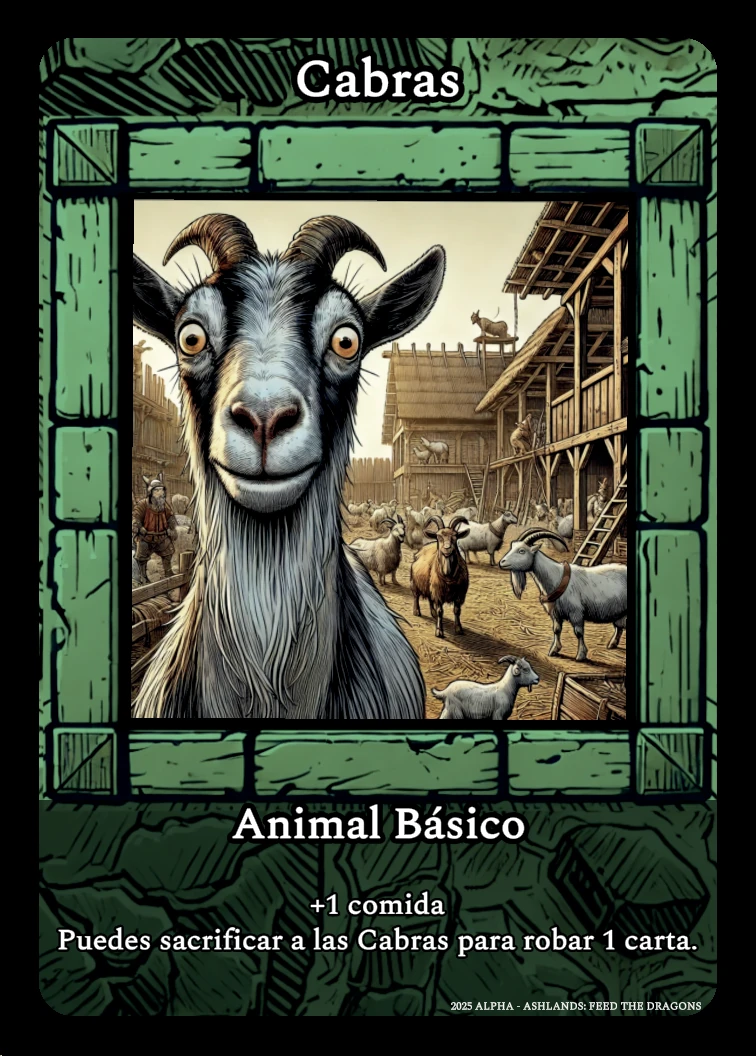
Original Vacas card: sacrificing it produces 2 foodOriginal Cabras card

ONE DECISION CAN CHANGE THE TABLE

Tribute keeps you alive.
A bribe strikes your opponents.

Sacrifice Cows to produce 2 food. Use one to feed the dragon and the other to eliminate an Animal or Villager in an opponent’s kingdom.

2food1tribute1bribe

Bribing is optional and can be done only once per turn. Check an Animal’s additional costs before sacrificing it.

THE DECK CAN CHANGE THE GAME

Threats, favors
and responses.

Follow these examples using base-game cards. During the game, reveal a Catastrophe, Divine Punishment, or Divine Favor as soon as you draw it, resolve it, and draw a replacement: it does not count toward your 3-card Draw Phase. Open the cards to read their original abilities.

01 / CATASTROPHES

An immediate blow
to every kingdom.

Catastrophes must be played immediately when drawn and cannot be kept in your hand. Peste Negra (Black Plague) makes every player eliminate 2 Villagers from their own kingdom.

  1. Reveal the Catastrophe immediately.
  2. Resolve its effect clockwise, starting with the player who drew it, unless an ability protects a player.
  3. Discard the Catastrophe and draw a replacement card.

Peste Negra example: a kingdom with 6 Villagers and no protection.

6Villagers before2eliminated4Villagers after

Vientos del Caos (Winds of Chaos) changes the decision: in order, each player chooses and eliminates 1 opposing Basic Recruit or Peasant. The printed card specifies which Villagers can be chosen.

Read in the English rulebook

02 / DIVINE PUNISHMENTS

The effect stays.
The tribute changes.

Reveal a Divine Punishment when drawn and leave it in play, affecting every player. While Dragones Hambrientos is active, tribute requires 2 food instead of 1.

  1. Reveal the Punishment, leave it active, and draw a replacement.
  2. Its effect continues while it remains in play.
  3. A new Punishment replaces the old one, sending it to the discard pile. Divine Favor can also eliminate it.

Example: sacrifice untapped Cows, with no other abilities changing the tribute.

2food from Cows2used for tribute0left for a bribe

The entire food bonus goes toward tribute: a bribe needs an additional resource. Draw only one Divine Punishment per turn; shuffle additional ones back into the deck and draw replacement cards.

Read in the English rulebook

03 / DIVINE FAVOR

A prayer eliminates
the active punishment.

When you draw Plegaria, reveal it and eliminate the active Divine Punishment: it leaves play and goes to the discard pile. Its effect stops applying to every kingdom. In this example, Dragones Hambrientos stops requiring two food.

  1. Reveal Plegaria and eliminate the active Punishment.
  2. Every player draws 1 card through Plegaria’s ability.
  3. Discard Plegaria and draw a replacement for the Divine Favor.

Example with one active Punishment: its effect ends for everyone.

1active Punishment1eliminated0active Punishments

The ability draw and replacement draw are separate: everyone receives Plegaria’s card draw; the player who drew the Favor also replaces it to continue the Draw Phase. With no other modifiers, tribute returns to 1 food or 1 Villager.

Read in the English rulebook

04 / REACTIONS

Change the target.
The bribe still resolves.

Play Reactions in any quantity during your turn or an opponent’s, at the time specified on the card.

An opponent sacrifices untapped Cows to produce 2 food: one pays tribute and the other pays for the bribe. The Cows card is already in the Discard Pile. Your opponent targets a Peasant in your kingdom with the bribe; you play Mal Momento y Mal Lugar to redirect it to a Peasant in a third player’s kingdom.

  1. Your opponent sacrifices Cows and pays 1 food for tribute and 1 food for the bribe. Both payments are complete.
  2. Your opponent targets your Peasant; respond with Mal Momento y Mal Lugar and choose a Peasant belonging to the third player as the new target.
  3. The Reaction resolves first. The bribe eliminates the Peasant you chose, instead of the original target. Your Peasant stays in your kingdom. Discard the Reaction after it resolves.

All food from Cows has already been spent: tribute and the bribe are paid.

2food from Cows1tribute paid1bribe paid

The Reaction only changes the target: it does not restore Cows or refund food. The sacrificed Cows stay in the Discard Pile, and the third kingdom loses 1 Villager. Choose another Villager or Animal as allowed by the card; if more responses are added, resolve the chain starting with the last card played or ability activated.

Read in the English rulebook

05 / EVENTS

Choose your Animals.
Bring them to your kingdom.

Opponent 1

1 Cows card · 1 Sheep card

Opponent 2

1 Goats card · 2 Sheep cards

During your Action Phase, you may play 1 Event per turn from your hand. With Robar el Banquete, you choose up to 1 Basic Animal from each opponent’s kingdom and place it in yours.

  1. At a three-player table, you have 1 Animal. Opponent 1 has Cows and Sheep; opponent 2 has Goats and two Sheep cards.
  2. Play Robar el Banquete and choose Cows from opponent 1 and Goats from opponent 2. Both chosen cards move into your kingdom; the remaining cards stay with their owners.
  3. Discard the Event after it resolves. You have now played your Event for this turn.

Your kingdom goes from 1 Animal to 3: you receive Cows and Goats from two different opponents.

1Animal before2Animals received3Animals after

The choice is yours: choose Cows or Sheep from opponent 1, then Goats or one of the two Sheep cards from opponent 2. Take up to one card from each opponent. Three players means two opponents: take up to 2 Animals. To take Cows, Sheep, and Goats in one resolution, you need three opponents, meaning four players. Only Basic Animals already in their kingdoms can be chosen.

Read in the English rulebook

These examples show isolated situations, with no other cards or abilities changing the outcome.

WHO LIVES IN YOUR KINGDOM

They are all Villagers.
Their role can change.

Villager includes Peasants (also called Commoners), Basic Recruits, and Mythical Recruits. Recruiting changes a Villager’s role: it still counts as one Villager.

Villagers

Peasants + Basic Recruits + Mythical Recruits

A Recruit is a Villager assigned to a Recruit card, which grants it abilities. There are two types: Basic and Mythical.

White Peasant miniature: a Villager token without a Recruit cardToken without a Recruit card

Peasant

A Villager who has not been recruited. Its token is in your kingdom without a Recruit card and has no Recruit abilities.

To recruit it, play a Recruit card and place its token on the card. It becomes a Basic or Mythical Recruit, depending on the card.

Basic Recruit

A Villager assigned to a Basic Recruit card. Its card grants a specific ability. Read the card to learn its effect, cost, and restrictions.

You may play 1 Basic Recruit per turn. Basic Recruits may coexist in your kingdom, subject to their printed abilities.

Mythical Recruit

A Villager assigned to a Mythical Recruit card, which grants a special ability. It remains both a Recruit and a Villager.

You may play 1 Mythical Recruit per turn. You may control more than one only if they share the same Faction and have different names. Otherwise, choose one to sacrifice.

One of each Recruit type per turn

The English manual allows 1 Basic Recruit and 1 Mythical Recruit per turn. Activate their abilities during your Action Phase, unless the card states otherwise. Printed abilities take precedence over general rules.

What each term includes

“Villager” includes Peasants and both Recruit types. “Recruit” includes Basic and Mythical Recruits. “Peasant” refers only to Villagers who have not been recruited.

Recruit and dismiss: the token stays the same

If you have 6 Peasants and recruit one as Sicario, you have 5 Peasants + 1 Basic Recruit = 6 Villagers. During the Final Phase, you may dismiss up to 1 Recruit: discard its card and keep its token in your kingdom as a Peasant. Dismissing does not eliminate or sacrifice the Villager.

Read the terminology in the English manual · Read the Recruit rules

A GAME THAT CHANGES WITH YOUR DECK

More cards.
New decisions.

Combine the base game with promotional and expansion cards to create different games and increase replayability.

01

Base game

The cards included with the game: 115 cards, including 15 Starter Basic Animals. The main playing deck contains 100 cards.

View base-game cards
02

Promotional cards

Unique cards included with a new-game purchase. Add them to the base game to change combinations and decisions from one game to the next.

View promotional cards
03

Expansion

Sold in packs of 7 cards. Add these extra cards to the base game for new abilities and combinations.

View expansion cards
Customize your deck and play again

The manual allows you to vary the deck with expansion cards. Promotional cards can also increase replayability. Add or replace cards when setting up; the recommended composition is 100 cards plus Starter Basic Animals, keeping the suggested proportions. Under the English manual’s Chaos Rule, a valid deck must contain at least 4 Divine Punishments and 8 Catastrophes. The expansion catalog does not represent the contents of a single pack.

If you replace the Starter Basic Animals with expansion options, use only Basic Animals producing at most +1 food. Printed abilities take precedence over general rules.

Read deck setup in the English manual · Read the Chaos Rule

THE PEOPLE AND THREATS OF ASHLANDS

Every card,
a way to survive.

Explore the original cards. Open one to read its printed ability and inspect the artwork. Card images and printed names remain in their original language.

KEEP THE RULEBOOK CLOSE

The rules that
sustain your kingdom.

Open the English rulebook

What you can play during your turn

TypeLimit and entry
Basic AnimalAny number. Enters tapped.
Mythical Animal1 per turn and 1 in your kingdom. Enters untapped.
Basic Recruit1 per turn.
Mythical Recruit1 per turn. Multiple may coexist only with the same Faction and different names.
Event1 per turn, only during your turn.
ReactionAt any time and in any quantity.
Is my hand limit always 5?

The general rule is to finish your turn with no more than 5 cards. Some abilities change this: Bardo increases your limit to 7. A printed ability takes precedence over a general rule.

What happens when I draw a Catastrophe?

Reveal and immediately resolve its effect for all players. Then discard it and draw a replacement: it does not count toward your 3-card draw.

How do Divine Punishments and Divine Favors work?

A Divine Punishment stays in play and changes the rules. A new one replaces the previous one. Resolve only one drawn from the deck per turn; shuffle additional ones back into the deck and draw again. A Divine Favor applies its effect, is discarded, and is replaced with another draw; read the card for its effect on the active Divine Punishment and any exceptions.

Can I sacrifice a tapped Animal?

No. Tapped Animals have no abilities and cannot be sacrificed. Basic Animals played this turn untap at the start of your next turn. Mythical Animals enter untapped.

What happens when the deck runs out?

Shuffle the discard pile to form a new deck and continue drawing.

How do chains resolve?

The last card played or ability activated resolves first. Earlier actions then resolve in reverse order until the chain is complete.

Does dismissing a Recruit eliminate the Villager?

No. During the Final Phase, you may unassign up to 1 Villager from its Recruit card. Discard the card and keep the token in your kingdom as a Peasant.

How does a game end?

If you run out of Villagers, you lose: discard your hand and the cards in your kingdom. The last kingdom with Villagers wins. If all kingdoms fall at the same time, the game is a draw.

Base game · First edition

This English guide follows the supplied English manual and uses a hand limit of 5 at the end of your turn. Customize the deck with promotional and expansion cards. For each card’s effect and costs, read its original image and the rulebook.

QUICK REFERENCE

Terminology

What each term means in this version of the game. These definitions follow the English rulebook. Printed card abilities take precedence over general rules.

Activate ability
Use the special effect of a card in play during your Action Phase, unless the card specifies another time.
Basic Recruit
A Villager assigned to a Basic Recruit card, which grants it abilities. You may play 1 Basic Recruit per turn; read its card for effects and restrictions.
Bribe the Dragon
After paying tribute, pay 1 extra food or sacrifice 1 additional Villager so the dragon eliminates a Villager or Animal in an opponent’s kingdom. This is optional, once per turn, within FEED THE DRAGONS.
Cemetery
Villagers who have been eliminated or sacrificed and are no longer in your kingdom. Each player has an independent Cemetery.
Chain Resolution
When abilities or reactions form a chain, resolve them in reverse order: the last one added resolves first.
Continuous effect
An ability that remains active while its card is in play. It stops applying when the card is eliminated or discarded.
Control
Have an active card in your kingdom. Controlling a Recruit means it is part of your kingdom.
Deck
The pile of cards that have not yet been drawn.
Discard
Send a card from your hand to the discard pile.
Discard Pile
The pile where cards that have been played or discarded are placed.
Dismiss
During the Final Phase, unassign up to 1 Villager from its Recruit card. Discard the card and keep the token in your kingdom as a Peasant. This does not eliminate or sacrifice the Villager.
Eliminate
Destroy a card in play and place it in the discard pile. Eliminating and sacrificing are different actions.
Faction
A Mythical Recruit’s affiliation or loyalty. You may control multiple Mythical Recruits only if they share the same Faction and have different names; sacrifice those that do not match.
Hand limit
Keep no more than 5 cards in hand during the Discard step of the Final Phase, unless a card changes the limit. Bardo increases it to 7.
Immunity
Protection from effects of the kind the card is immune to.
Kingdom
Your play area, containing your Villagers and Animals. An ability that affects you also affects your kingdom.
Mythical Recruit
A Villager assigned to a Mythical Recruit card, which grants a special ability. You may play 1 per turn. Multiple may coexist only if they share a Faction and have different names.
Paying for food
To generate food with an Animal or Villager, sacrifice it. A tapped Animal cannot be sacrificed. Read the card for its food bonus and any additional costs.
Peasants
Villagers who have not been recruited, also called Commoners. Their tokens are not assigned to Recruit cards and have no Recruit abilities.
Play a card
Use a card from your hand: place it in your kingdom, or use its effect and send it to the discard pile, as with an Event or Reaction.
Played card
A card placed in the kingdom or whose effect was used from the hand. A card entering play through another card’s effect does not count as a played card.
Recruits
Both Basic and Mythical Recruits. They remain Villagers. This English rulebook allows 1 Basic Recruit and 1 Mythical Recruit to be played per turn.
Remove from the game
Set the card aside from the match. It cannot be used or recovered by any effect.
Sacrifice
Give up cards in play to pay tribute, generate food, or pay for a game action that requires it, sending them to the discard pile. Sacrificing is different from eliminating.
Tapped Animal
A wounded or newborn Animal that must grow. It has no abilities and cannot be sacrificed.
Tribute to the Dragon
Pay 1 food or sacrifice 1 Villager during the Tribute Phase, within FEED THE DRAGONS. Resolve tribute before the optional bribe.
Turn Order
When an ability requires every player to perform an action, resolve it clockwise.
Untapped Animal
An adult Animal with abilities that can be sacrificed for the food bonus on its card.
Villagers
All your Peasants (Commoners), Basic Recruits, and Mythical Recruits. Recruiting changes a Villager’s role without increasing your population.


Read the terminology in the English rulebook

QUESTIONS AND NEWS

Ask the creator.

Have a question for Bruno about Ashlands? Send it privately from your account or email him.

Ashlands news

Enable the subscription in your profile to receive game news by email. You can turn it off whenever you like.

Manage my subscription

View full image

Search the site

Enter a word or phrase to search.